







A two-story red brick house with black shutters and a chimney stands on a mown lawn framed by large deciduous trees, viewed from behind a dry-laid stone wall in the foreground under an overcast sky.

AC Repair in Dover, NH

Tell us about the job

Takes about a minute. No obligation.

RepairCentral ACStrafford County, NH
Step 1 of 2

What ZIP code is the job in?

Dover gets two months of real cooling, July and August, with afternoons averaging around 79 degrees. That is a mild season compared to most of the country, and your AC spends most of the year doing nothing at all. A system that sits idle that long usually has less wear on it than the numbers alone would suggest. If yours is acting up, the cause is more likely age, a neglected filter, or a part that failed on its own than a unit that has been run into the ground. That is usually a system worth fixing.

2 months
July through August, your air conditioner is on duty
79°F
the average summer afternoon it cools against
9 hail events
in ten years, and hail bends the fins on outdoor coils
43 wind events
in ten years, and wind drives debris into outdoor units
Isometric 3D cutaway render of a house with dark siding showing interior rooms, ductwork and an air handler, connected by lines to an outdoor condenser unit on a white background.
Your air conditioner works hardest from July through August.

NOAA nClimDiv, 1991–2020 normals

Half the homes in Strafford County were built in 1979 or later.

A system that came with a newer house usually still has years left in it, and a repair keeps the AC running through them.

Two mild months a year isn't what wears an AC out

Power costs 23.4 cents a kWh statewide
Cooling runs July through August
Summer afternoons average 79°F
The first hot week finds the weak partCooling in Strafford County runs July through August. June is when it's worth checking what you have before the heat hits it.

A refrigerant leak is the clearest example of a problem that gets worse the longer the system runs. Low charge makes the compressor work harder to move heat, and it runs hotter doing it. Keep that up and the compressor itself takes the damage, not just the refrigerant line. A weak capacitor works the same way. The system still starts, but the motor strains on every cycle until the motor fails instead of the capacitor. Ice on the coil is its own warning sign. Once a coil starts icing, airflow drops further, more ice builds, and a simple airflow problem turns into a frozen coil that cannot cool anything at all. None of these fix themselves by running longer. They just move the damage from one part to another, bigger one.

An easy life like this one is worth repairing

Get it looked at. A system that has had an easy life and sits in good shape is worth repairing rather than replacing, and that is the usual case here. The sooner a worn capacitor or a low charge gets caught, the less chance it takes the compressor down with it.

Find a contractor
A man in a gray long-sleeve shirt and brown pants, seen from behind, carries a canvas tool bag up wooden steps toward a green front door.
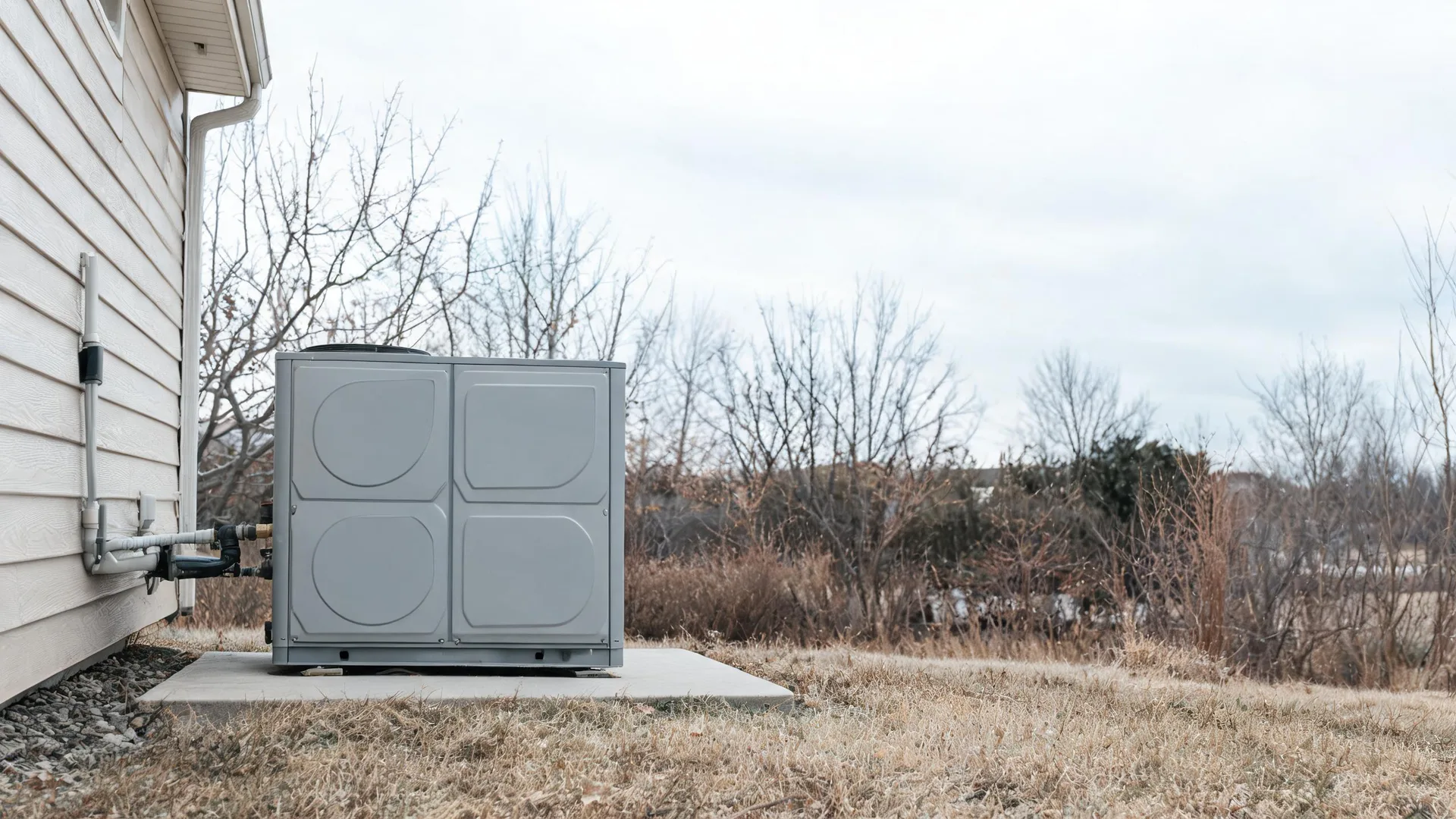
A gray metal air conditioning condenser unit mounted on a concrete pad in a flat grassy field under a partly cloudy sky.

A newer system has more years to give back

If your system came with the house, that puts its age somewhere around the house's own age, and half the houses here were built in 1979 or later. A system with years still on it is worth running the clock out on rather than replacing early. That's what a repair does here. Get the part fixed, whether it's a capacitor or a refrigerant leak, and let the system use the life it still has left.

Check the filter first

A clogged filter starves the system of airflow, and a coil without enough airflow across it can ice over even on a hot day. Pull the filter and hold it up to a light. If light barely gets through, replace it. This alone fixes a surprising number of weak-cooling complaints.

Look at the outdoor unit

Walk outside and check the condenser. Leaves, grass clippings, or a fence line crowding the cabinet all block the airflow it needs to dump heat outside. Clear anything within a couple feet of it. Also listen for it running at all. If the indoor blower is going but the outdoor unit is silent, that points to the capacitor or the contactor, not something you can fix yourself, but worth telling the tech exactly what you heard.

An overhead view of a residential air conditioning condenser unit mounted on a concrete pad next to a house with vinyl siding.

A new air conditioner would save little on running costs in Strafford County, so the repair decision comes down to the unit's condition.

  • A new one at the federal minimum, 13.4 SEER2$230 a year
  • An older air conditioner$250 a year

Estimates for a typical Strafford County home, compared with an older unit built to the previous federal minimum, from EIA household energy data, New Hampshire fuel prices and NOAA climate normals. Your home will differ.

Repair makes sense when a part like a capacitor or contactor has failed.

Replacement makes sense when the compressor has failed or the system uses R-22 refrigerant, which is no longer made.

A diagnostic call starts outside, at the condenser. The tech checks that it's actually running and pulling air through the fins. From there it's the electrical side, the capacitor and the contactor and the wiring between them. A capacitor gets tested under load, not just looked at, because a weak one can still turn the fan while it's failing. Inside, the coil gets checked for ice or buildup, and the ductwork gets a look to see whether the system is pulling and pushing air the way it should. Refrigerant charge gets checked last. Charging a system before ruling out an airflow problem just covers up what's actually wrong. By the end you should have a straight answer on which part failed, not just that something did.