White colonial houses with lit windows and dark shutters line a tree-lined street at dusk, bordered by dry-stacked stone walls.

Heat Pump Repair in Concord, NH

Tell us about the job

Takes about a minute. No obligation.

RepairHeat PumpMerrimack County, NH
Step 1 of 2

What ZIP code is the job in?

Check the simple things first

Look at the thermostat and make sure it's set to heat and calling for a temperature above room temp. Check the breaker panel for a tripped switch, since a heat pump has separate breakers for the indoor and outdoor unit. Walk outside and look at the outdoor unit for ice buildup or anything blocking the coil, like leaves or snow piled against it.

Know what to leave alone

Don't chip away at ice on the outdoor coil or pour water on it, and don't open the outdoor unit's cabinet. If the system is running but blowing air that feels cool even though it's set to heat, that can be normal for a heat pump and isn't something to chase down yourself. A technician needs to check refrigerant charge and the reversing valve with gauges, not a visual check.

9 months
September through May, your system heats
2 months
July through August, it cools
14°F
the average winter night it heats against
79°F
the average summer afternoon it cools against
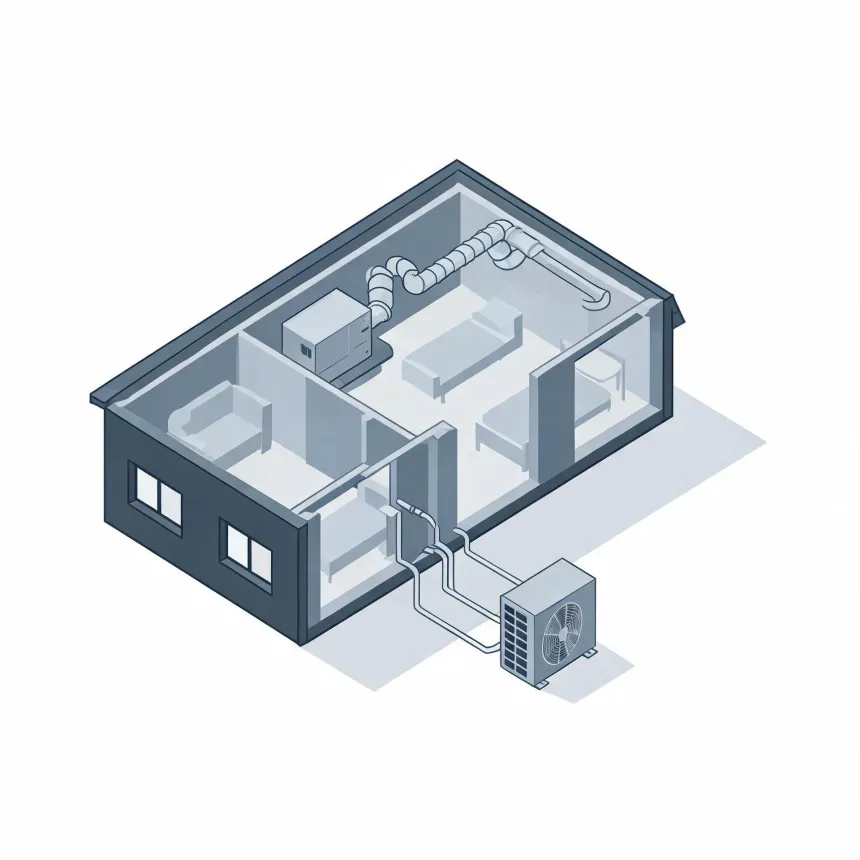
Isometric cutaway illustration of a small house showing interior rooms with furniture, an indoor air handler with flexible ducting, and refrigerant lines running to an outdoor condenser unit beside the building.
Your system heats September through May and cools July through August.

NOAA nClimDiv, 1991–2020 normals

Half the homes in Merrimack County were built in 1977 or earlier, and half in 1977 or later.

A heat pump in an older house or a newer one usually breaks for the same handful of reasons, so the fix is usually the ordinary one.

Concord sees its share of wind, hail and snow. A heat pump here breaks for the same reasons it would anywhere else.

79 damaging wind events from 2015 to 2024
21 hail events from 2015 to 2024
35 winter storms from 2015 to 2024

Merrimack County has logged 138 severe weather events between 2015 and 2024, and a good share of those were damaging wind and hail. That matters for a heat pump because the outdoor unit sits outside year round and takes whatever blows through, unlike a furnace tucked in a closet. A dented cabinet or bent fins are worth ruling out, even on a unit that still runs. Hail can bend the fins enough to choke airflow over the coil without stopping the system outright. If the outdoor unit took a hit, have a technician check the coil and fins rather than waiting for it to act up.

A heat pump running wrong costs more here than most places

Electricity in New Hampshire ran 23.40 cents per kilowatthour in 2024, well above the national average, and a heat pump that's low on charge or struggling to defrost runs longer to make the same heat. That shows up on next month's bill before it shows up as a breakdown. Worth having someone check it now.

Find a contractor
A dark gray heat pump unit mounted on a concrete pad next to a house with gray siding and a stone veneer wall.

It runs both directions, all year

A heat pump runs in both directions, all year. That is just more hours on the parts than a system that only heats or only cools gets, and it points to the same handful of usual suspects. The reversing valve is the one that is unique to a heat pump, since it is what switches the system between heat and cool, and it can start sticking in one position after enough cycles. The defrost control is another. It has to sense frost on the outdoor coil and run the system backward briefly to clear it. When that sensor or board fails, ice keeps building until airflow chokes and the unit trips off. The outdoor fan motor and compressor wear from plain runtime, and a weak capacitor will often show up first as the fan struggling to start. None of this means the unit is near the end. It means the parts that cycle the most are the ones worth checking first.

What you'll actually notice first

Short cycles are usually the first thing an owner picks up on, the system kicking on and off every few minutes instead of running a normal stretch. Weak airflow from the vents is another, along with rooms that never quite reach the set temperature no matter how long it runs. A hissing or bubbling sound near the indoor unit points to refrigerant, and a burnt smell on startup points to the blower motor or a wiring problem, not something to wait out.

What decides if it's worth fixing

A unit that's needed a few unrelated repairs in the last couple years is telling you something different than one that's never been touched and suddenly trips a breaker. A compressor failure is usually the one that ends a unit's life, since it's the hardest part to replace and the rest of the system often isn't worth running much longer without it. Most everything else, a bad capacitor, a failed sensor, a stuck reversing valve, is a straightforward repair on a system that's otherwise sound.

A heat pump that's struggling will keep trying to hit the set temperature instead of shutting itself off, and that's what turns a small problem into a bigger one. A refrigerant leak gets worse because the compressor keeps pumping what's left through the system, and running low on charge for weeks wears the compressor harder than the leak itself would. Ice on the outdoor coil is the same story. If the defrost cycle isn't clearing it, every hour of runtime packs on more ice, chokes off more airflow, and makes the compressor work against a coil that can't do its job. A weak capacitor that's letting the fan motor struggle to start puts a strain on that motor every single cycle, and motors fail from heat built up over many cycles, not all at once. None of these start as a breakdown. They start as the system working harder than it should, and the longer that goes on, the more parts are doing extra work to cover for the one that's failing.

A compressor failure is the one that usually decides this. Replace a compressor on its own and it carries no warranty worth having, since a compressor only fails like that when something else in the system drove it there, and that something else is often still a problem. Most other failures don't carry that weight. A reversing valve, a capacitor, a defrost sensor, a blower motor, these get swapped out and the system runs like it did before, because the rest of the unit was never the issue. Age by itself isn't the test either. A heat pump that's had a repair here and there over its life is just a machine that's been maintained. One that keeps coming back for the same symptom, or that now needs another major part on top of a compressor or coil repair, is a different case. That pattern means the system is spending its repair budget to stay even, not to get fixed.