





Two white multi-story colonial houses with lit windows and black shutters photographed at night, fronted by a stone wall.

Heat Pump Repair in Keene, NH

Tell us about the job

Takes about a minute. No obligation.

RepairHeat PumpCheshire County, NH
Step 1 of 2

What ZIP code is the job in?

Most heat pump failures trace back to a handful of parts. The reversing valve is a common one. It switches the system between heating and cooling, and when it sticks, you get heat when you want cool, or no change at all. The defrost board is another. It tells the unit when to melt the frost off the outdoor coil in cold weather. When it fails, ice keeps building until the unit can't pull any more heat from the air. Capacitors wear out too. They give the compressor or fan motor the jolt it needs to start, and a weak one means the outdoor unit hums without starting, or the fan turns slowly. Low refrigerant charge is usually a slow leak, not the system using up refrigerant like fuel. It shows up as a system that runs and runs without getting the house to temperature. Any of these can look the same from inside the house, a unit that runs but doesn't heat or cool the way it used to.

9 months
September through May, your system heats
2 months
July through August, it cools
15°F
the average winter night it heats against
78°F
the average summer afternoon it cools against
Isometric line illustration of a cutaway single-story house showing interior ductwork, an indoor air handler unit, and an outdoor condenser connected by refrigerant lines, with a dark shingled roof.
Your system heats September through May and cools July through August.

NOAA nClimDiv, 1991–2020 normals

Electricity in New Hampshire ran 23.40 cents per kilowatt-hour in 2024, among the higher rates in the country.

A heat pump stuck on a bad reversing valve or low charge runs longer to do less, and at this rate that shows up fast.

Nothing here pushes a heat pump harder than the cold itself

164 damaging wind events from 2015 to 2024
43 hail events from 2015 to 2024
34 winter storms from 2015 to 2024

Heat pump here works nine months a year, September through May, with August the month to get it looked at before that stretch starts. Cold hits the defrost board and the reversing valve hardest, since both are built around the switch into heating mode. A unit that sat fine on cooling all summer can still have a weak capacitor that only shows itself once the compressor has to work harder in the cold. Get it checked in August and a technician finds that before the first cold morning does.

Your heat pump may be as old as the house it heats

Half the homes in Cheshire County were built in 1972 or earlier. A heat pump that came with a house that age has likely been running a long time already, and the parts that fail first, the reversing valve, the defrost board, the capacitor, wear out with age and use. A repair might be the right call, or the unit might be close to done either way.

Find a contractor
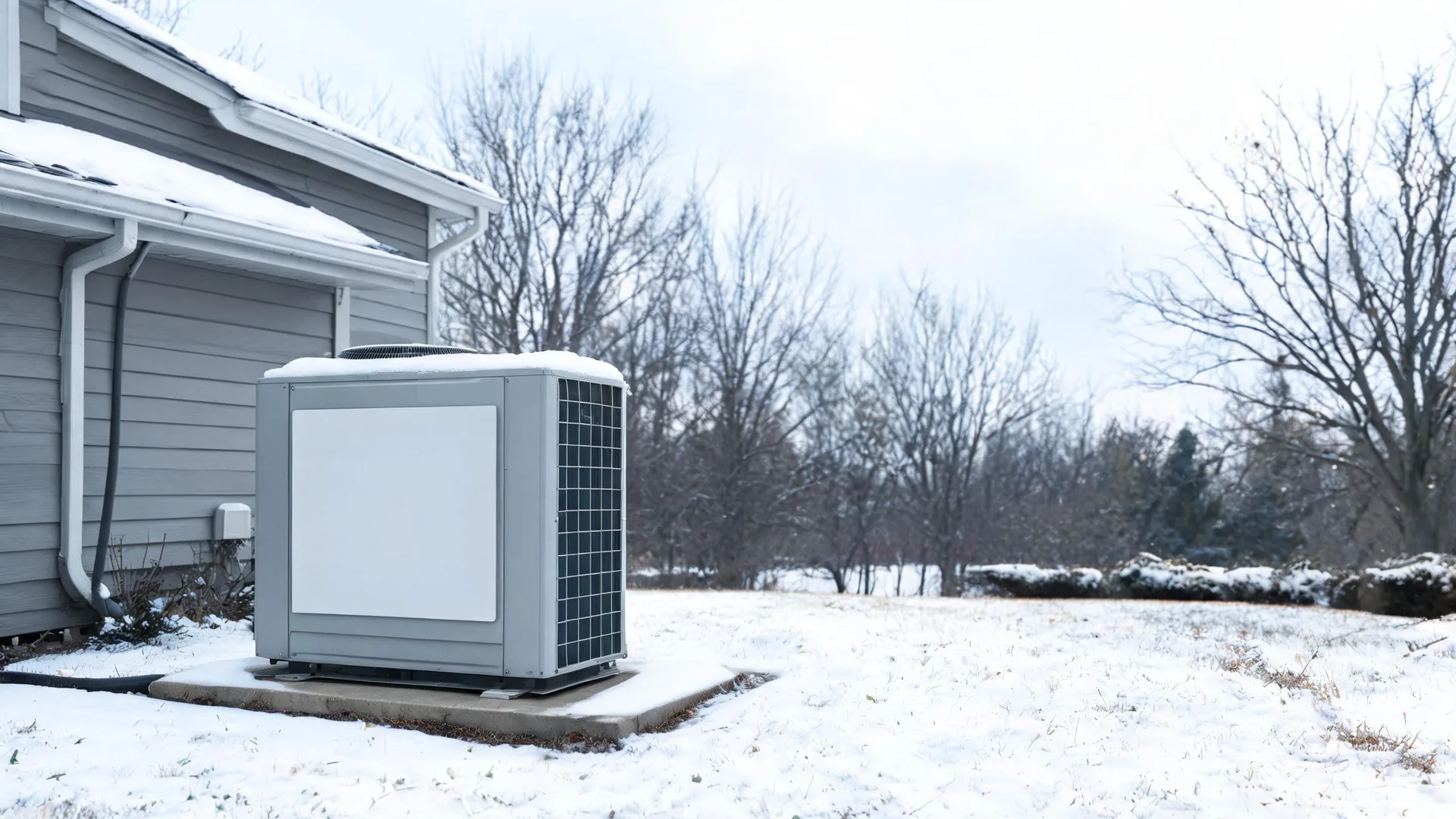
A gray outdoor HVAC unit mounted on a concrete pad beside a house with gray lap siding and a stone foundation.

The unit tells you before it quits

A heat pump doesn't fail all at once. It gives notice first, and most of that notice shows up as sound or behavior you can actually catch. A clicking at the outdoor unit that doesn't resolve into a run cycle often means a capacitor trying and failing to start the compressor. A hissing or bubbling near the lines points to refrigerant escaping somewhere it shouldn't. Short cycling, where the unit kicks on and off every few minutes instead of running a full cycle, usually traces back to a control board or a sensor giving it bad information. Warm air out of the vents on a heat call is the reversing valve not finishing its switch. None of these fix themselves by waiting, and a system left to run through them usually trades one bad part for a second one.

What you can check yourself

Look at the outdoor unit first. If it's packed in ice or snow, clear it away so air can move through the coil. Check that nothing is blocking it, no branches, no siding, nothing stacked against it. Inside, check the thermostat is set to heat and the temperature is actually above room temperature. Check your breaker panel for a tripped breaker before assuming the unit itself failed. Change the air filter if it's dirty. A clogged filter can starve the system of airflow and make it seem like a bigger problem than it is.
What to leave alone

Don't open the outdoor unit's panels or touch the refrigerant lines. Low charge gets fixed by finding and sealing the leak, not by adding refrigerant yourself, and the lines carry both electrical and pressure risk. Don't keep flipping the thermostat between heat and cool trying to force a response, that's hard on a reversing valve that may already be sticking. If the unit is icing over even after you clear it, or it runs constantly without warming the house, that's a sign for a technician, not something to chase down further on your own.

A heat pump that's struggling doesn't rest when you leave it running, it just fails along the same path faster. Low refrigerant charge is a good example. The system keeps trying to reach the temperature on the thermostat, so the compressor keeps working, and a compressor pushed to run constantly on a low charge wears out well before its time. Ice on the outdoor coil behaves the same way. Left alone, it blocks more and more airflow, the system pulls harder to compensate, and what started as a defrost board not cycling right can end with a compressor that seized up trying to work through the ice. A reversing valve stuck halfway is another one. The system isn't heating or cooling right, so it runs longer to get nowhere, and that extra strain on a part already failing tends to finish the job. None of this means every noise or short cycle is an emergency. But a unit that's clearly not keeping up and is still running flat out is usually better off shut down until someone looks at it than left on to fight itself.

A repair is worth it when the part that failed is the only thing wrong with the system. A bad capacitor, a stuck reversing valve, a defrost board that won't cycle right, these are single parts doing one job, and swapping the part brings the whole unit back to normal. Replacement starts to make more sense when the compressor itself is the problem. The compressor is the heart of the system, and there's no small fix for one that's worn out or seizing, only a new one, which usually costs close to what a new system runs. It also matters how the unit's been acting before this. One part failing is normal wear. Several parts failing over a short stretch usually means the unit's reached the point where things start going one after another. A technician can tell you which kind of situation you're in once they've actually looked at what failed and why.