A weathered wooden picket fence runs diagonally across a mown grass lawn, with a row of two-story light-sided houses and large leafy trees behind it.

Heat Pump Repair in Portsmouth, NH

Tell us about the job

Takes about a minute. No obligation.

RepairHeat PumpRockingham County, NH
Step 1 of 2

What ZIP code is the job in?

How old the heat pump is matters more than what's wrong with it

A heat pump nearing the end of its working life will keep throwing new problems even after you fix the one in front of you. The compressor is the part that decides this. If it's still sound, a bad capacitor or a failed reversing valve is just a repair. If the compressor itself is failing, the unit is on its way out no matter what else gets replaced.


A refrigerant leak changes the math

Low refrigerant doesn't get used up, it leaks out, and a leak means a hole in the coil or a bad fitting somewhere in the line set. Finding and sealing it can be straightforward or it can mean replacing a coil that's hard to get to. Before you spend money chasing a leak, it's worth knowing whether the system is old enough that the leak is a symptom of the whole unit wearing out rather than one bad spot.

8 months
October through May, your system heats
2 months
July through August, it cools
18°F
the average winter night it heats against
80°F
the average summer afternoon it cools against
Isometric line illustration of a cutaway single-story house showing interior rooms, ceiling ductwork connected to an indoor air handler, and refrigerant lines running to an outdoor condenser unit on a pad.
Your system heats October through May and cools July through August.

NOAA nClimDiv, 1991–2020 normals

September is the month before heat comes on here, and it's the best time to get a heat pump looked at.

Heat pumps in Rockingham County run October through May, and a weak part tends to fail in the season's first cold weeks.

A heat pump that's struggling still runs on Portsmouth's power rates

Power costs 23.4 cents a kWh statewide
103 damaging wind events from 2015 to 2024
29 hail events from 2015 to 2024

Half the homes in Rockingham County were built in 1983 or later. If yours is one of them, your heat pump likely came with the house or replaced an aging unit on a normal schedule, not after years of being pushed past its working life. That matters when something goes wrong. A newer compressor with a bad capacitor is a repair. A newer coil with a leak is a repair too. Age is the thing that turns a repair into a losing bet, and a lot of homes here simply haven't gotten there yet.

Most heat pump problems here are just that, a problem with the heat pump

Winter storms and wind are common in Rockingham County, but that's not what's hard on your heat pump. The usual culprits are a bad capacitor, a failing reversing valve, or a refrigerant leak, the same things that go wrong with this equipment anywhere. A technician can look at yours and tell you which one it is.

Find a contractor
A man in a cap, gray T-shirt and tan work pants carries a canvas tool bag up porch steps toward a green front door of a lap-sided house, with a potted shrub to the right.
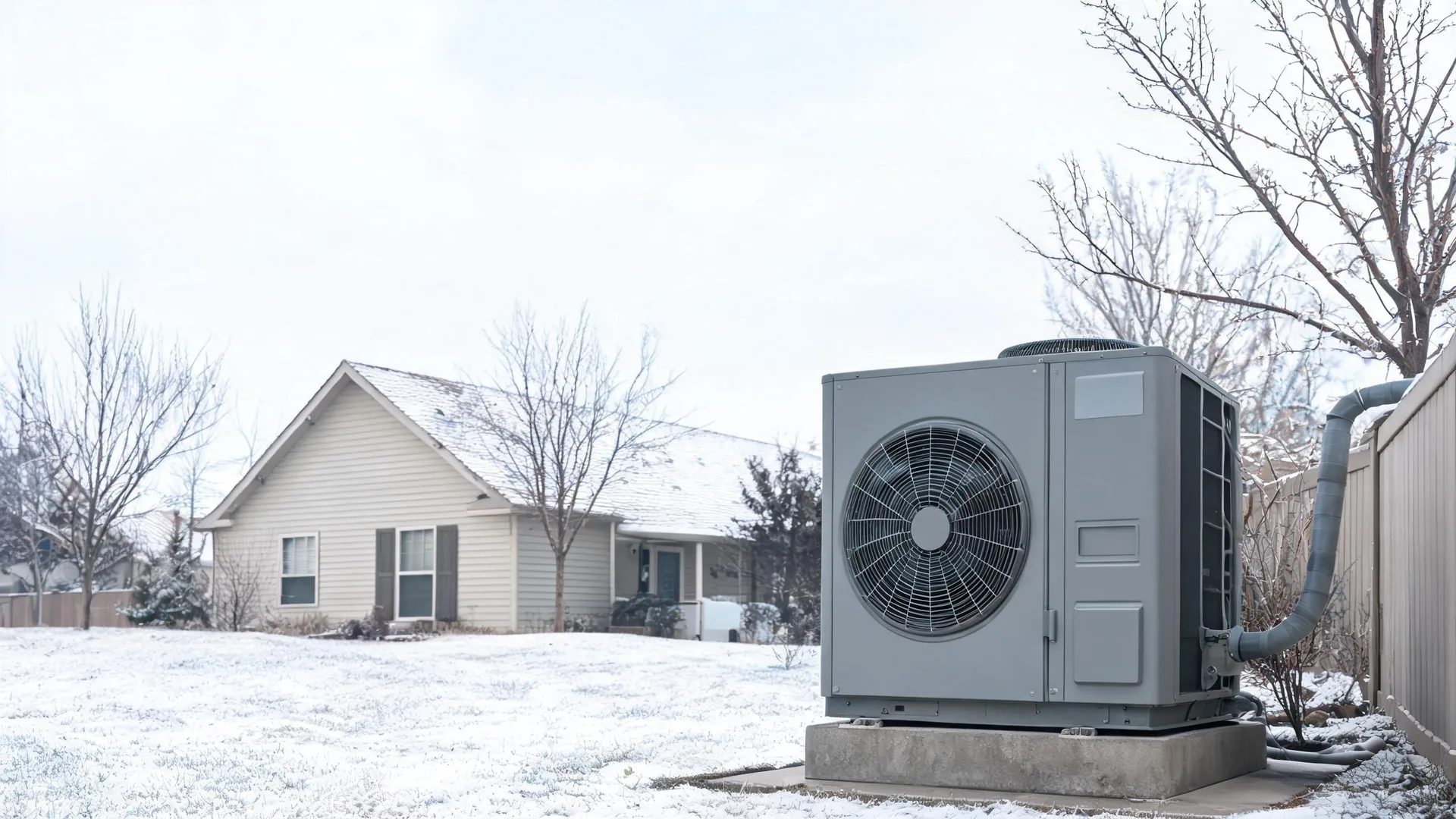
A gray heat pump condenser unit mounted on a concrete pad against the gray lap-siding exterior wall of a house.

What to check before you pick up the phone

Before anyone comes out, check the thermostat batteries and the setting itself. A thermostat set to the wrong mode will make a heat pump look broken when it isn't. Next, look at the outdoor unit. If it's packed in ice or snow, or leaves are blocking the coil, clear what you can reach without tools. Inside, check the air filter. A clogged filter starves the system of airflow and can cause problems that look electrical or mechanical but aren't. Check the breaker too. A heat pump that won't start at all sometimes just lost power, and resetting a tripped breaker once is safe. If it trips again, stop and leave it alone, that's a sign of a real electrical fault. Walk through the house and note which rooms feel wrong and when the problem started. That timeline is worth more to a technician than anything else you can hand them.

It won't switch between heating and cooling

A heat pump that blows cold air when it should be heating, or won't reverse at all, usually has a stuck or failing reversing valve. Sometimes it's just stuck in one position and a technician can free it. Other times the valve itself has failed and needs replacing.

It runs all the time but the house never feels right

A heat pump that never shuts off but still leaves rooms too cold or too warm is losing capacity somewhere. That can mean a weak compressor, a refrigerant leak, or a failing fan motor not moving enough air across the coil. Short cycling, where it starts and stops in quick bursts, points a different way, usually toward a bad capacitor or a thermostat sensing something wrong.

A heat pump with a struggling part doesn't just sit still and wait for attention. A reversing valve that's starting to stick gets worse each time it's asked to switch, until one day it doesn't switch at all. A capacitor that's weak makes the compressor pull harder to start, and that strain shortens what's left of the compressor's life. A small refrigerant leak lets the compressor run low on charge, and a compressor running low on charge runs hotter than it should, which wears it down faster than the leak alone ever would. The problem you'd pay to fix today is rarely the same size as the one you'll pay to fix in a month if the unit keeps running on it.

A diagnostic visit starts with questions, not tools. What's it doing, when did it start, does it happen in heating or cooling or both. Then a technician checks pressures and temperatures at the unit, because those numbers say more than a visual look ever could. The electrical side gets checked too, since a capacitor can test weak before it fails outright, and a contactor can be pitted enough to cause trouble without having failed yet. If the complaint is about airflow, the coil and blower get a look, since a dirty coil or a weak motor can mimic a refrigerant problem. The point of all this is to find the actual failing part before replacing anything, not to start swapping components and see what helps.