A gray outdoor heat pump unit on a concrete pad beside a dark horizontal-siding wall, with a small electrical box on the wall, shrubs and a concrete walkway to the right at dusk.

One form, no calling around

Why your heat pump runs on emergency heat in New Hampshire

If your heat pump switched to emergency heat, something stopped it from running the normal way, and on New Hampshire power rates that mode gets expensive fast. This page gets into what usually causes the switch. Skip calling around and explaining the problem twice. A local contractor who services heat pumps all winter can take a look.

Fill out one form

Emergency heat means the heat pump itself has stopped and the backup heat strip is carrying the house on its own. It's a manual setting, not something the system jumps to on its own when it gets cold outside, so if it's running, either someone switched it or the outdoor unit is in trouble. New Hampshire winters push heat pumps hard, and when ice builds up on the outdoor coil and doesn't melt off on its own, or the outdoor fan stops turning, or the system loses refrigerant, the unit can't pull heat from the outside air anymore. The switch is there so you still have heat while that gets fixed. Left on emergency heat, the strip is running the whole heating load with electricity alone, and on New Hampshire rates that shows up on the bill within a month. The fix is finding out why the heat pump itself stopped carrying the house, not leaving it on backup.

A gray outdoor air conditioner condenser unit on a concrete pad beside a house with horizontal lap siding and a stone veneer base, with a conduit running to a wall-mounted disconnect box and shrubs and evergreen trees to the left.

Running the way it should

The outdoor unit cycles on and off as the house calls for heat, the fan runs, and the lines stay clear of frost buildup beyond a thin coat that melts off during normal defrost cycles. Air coming out of your vents feels warm, not lukewarm.

An outdoor air conditioning condenser unit sits on a concrete pad beside a white horizontal-siding house, with a gray electrical disconnect box and insulated refrigerant lines on the wall, mulch and green shrubs to the right, and a concrete slab in the foreground.

Stuck on emergency heat

The outdoor unit sits idle no matter how cold it gets outside, even though the thermostat shows it's calling for heat. Ice builds up on the coil and stays there, or the unit never kicks on at all. That's the backup strip carrying the whole house, and on New Hampshire rates you'll see it on the bill before the month is out.

How does the thermostat know to switch over to emergency heat?

You didn't touch the setting, but the thermostat is showing emergency heat anyway. You want to know whether that's the thermostat making a call on its own, or whether it only does that because something told it to.

It only switches because the heat pump sent it a signal, not on its own

The thermostat doesn't measure anything that tells it to go to emergency heat by itself. It switches over when the outdoor unit sends a fault signal back to it, usually through a low voltage wire called the O/B or E terminal depending on the thermostat. That signal means the outdoor unit has locked itself out, often from a pressure switch tripping or a sensor reading something out of range. Some thermostats also have an emergency heat setting a person can switch manually, which is why it's worth checking if anyone bumped it. Either way, the thermostat is reporting what the heat pump told it, not deciding on its own that the house needs backup heat.

A gray outdoor heat pump unit on a concrete pad beside a house with gray horizontal siding, with conduit and an electrical box on the wall and a shrub at left.

Why the switch costs so much more

The backup heat in your air handler is electric resistance heat, strips of wire that glow hot like a toaster. It makes heat by brute force, not by moving it the way the heat pump does. On New Hampshire electric rates, running those strips to heat a whole house costs far more per hour than the heat pump running normally. A thermostat left on emergency heat through a cold stretch shows up on the next bill.

An outdoor air-source heat pump unit with a dark grille stands on a concrete pad beside a white wall and wood-clad facade, surrounded by gravel.

What a frozen outdoor unit means

A heat pump outdoors collects heat from the outside air, and in winter it frosts up as it does that. Normally it runs a defrost cycle, reversing briefly to melt that frost, then goes back to heating. If the coil stays coated in thick frost or ice instead of a light coating that clears on its own, the defrost cycle isn't completing, and that's one of the common reasons a system gets switched to emergency heat until someone can look at it.

Wait It Out or Get It Fixed

Leave it on emergency heat

  • The house stays warm while you wait, because the heat strips don't care what's wrong with the outdoor unit.
  • Electric resistance heat has almost nothing to go wrong with it, so it keeps running even if the compressor or a sensor has failed.
  • You lose whatever a working heat pump would have saved you, and on New Hampshire electric rates that difference shows up fast.
  • The outdoor unit sits idle the whole time, which doesn't fix anything, it just stops the problem from getting worse.
  • If the cause is a frozen coil or a stuck valve, leaving it alone that long can mean more parts need replacing once someone looks at it.

Get the heat pump looked at

  • A contractor who works on heat pumps all winter can usually tell within minutes whether it's the thermostat wiring, a low charge, or the outdoor unit itself.
  • Once the actual fault is fixed, the thermostat switches out of emergency heat and the heat pump goes back to doing the job the strips were covering for.
  • You call one contractor instead of several, so you're not fielding callbacks from three companies while you're trying to figure out who's actually available.
  • You explain what happened once, not again to each company you call around to.
  • Catching it now instead of running on strips all season is the difference between a repair and a bigger bill once something else fails downstream.
A gray outdoor condenser unit on a concrete pad beside a house with horizontal lap siding, with a metal disconnect box and refrigerant lines on the wall, river rock and mulch to the sides, and a green shrub at right.

Outdoor unit, clear and running

The fins stay open so air moves through them the way the system expects. A coat of frost during a defrost cycle is normal, and it melts off within minutes. Gravel and open space around the pad keep debris away from the coil, and the unit cycles on and off without strain.

A dirty outdoor air conditioner condenser unit with debris on its coil grille, sitting on a concrete pad beside a light-colored horizontal siding wall, with bare dirt ground in front and a shrub at right.

Outdoor unit, clogged and failing

Dirt and plant matter packed into the grille block the airflow the coil needs to pull heat from outside air. The compressor works harder against that restriction, frost builds up and doesn't fully clear on defrost, and a unit left like this is a common reason a heat pump gives up and hands the house to emergency heat.

A woman with shoulder-length brown hair wearing a beige knit cardigan sits in a gray upholstered armchair near a window, looking off to the side with a slight smile, with bookshelves blurred in the background.
A woman and a child wrapped together in a knitted gray blanket on a couch, with the child's head resting on her shoulder and a lit table lamp and houseplant in the background.
A gray outdoor condenser unit of an air conditioner or heat pump sits on a concrete pad beside a house with horizontal lap siding, with a wall-mounted disconnect box and conduit above it, mulched beds, shrubs and grass nearby.

Skip the search

The pro who reaches out is licensed in New Hampshire.

Answer a few questions instead of calling shop after shop.

Skip the search

You only hire the pro if you want to.

A gray-haired man in a dark sweater sits on a light gray sofa in a living room, looking toward a sunlit window with trees outside.
A gray-haired man in a dark blue sweater sits on a light gray sofa in a sunlit living room, looking off to the side, with a potted plant, shelving unit, and large glass doors behind him.
A bearded man with graying hair in a dark green sweater sits on a sofa in a living room, looking off to the side, with a sliding glass door and a dim kitchen doorway behind him.
A gray-haired man in a dark knit sweater sits on a light gray sofa in a living room, looking toward a sunlit window, with houseplants, a lamp, and framed art in the background.
A two-story house with light beige horizontal siding, a gabled roof, a small covered front porch with dark door, and shrubs along the foundation, set behind a mown lawn and wet sidewalk with large leafy trees on both sides.

New Hampshire summers don't feel heavy, and the numbers back that up. Averaged across June, July and August, the dew point here runs 59°F, which is on the dry side as these things go. That matters for the other half of what your heat pump does. A heat pump that isn't fighting damp air all summer sees less wear on the compressor and the coil, which is the same hardware that has to carry the house come winter. So when it switches to emergency heat in January, the cause usually isn't a unit worn down by a hard summer. It's something specific that failed, and that's what gets found.

NASA POWER T2MDEW county cells weighted by homes

A gray outdoor condenser unit on a concrete pad beside a house with gray lap siding, connected by conduit and refrigerant lines to a wall-mounted disconnect box, with a green shrub and mulch bed at left.
The lines and conduit run clean to the disconnect, and the coil stays free of dirt, so the heat pump can move heat instead of fighting its own airflow.
An outdoor air conditioning or heat pump condenser unit on a concrete pad beside a house with horizontal vinyl siding, a gray electrical disconnect box and conduit on the wall, and a concrete walkway in the foreground.
Dirt packed into the coil and a unit left to sit like this makes the compressor work harder, and that's often what pushes a system into emergency heat.

What are you noticing in the house right now

The vents are still putting out warm air, so nothing feels broken at first. What you'll notice is the outdoor unit sitting still, or the fan running without the compressor making its usual sound. The air coming out of the vents may feel hotter than the heat pump normally delivers on its own, because the strips are doing the work now. Your electric bill is the other sign, usually a month behind, higher than a normal January or February even if the weather didn't change. If the switch happened because something failed outside, like a stuck sensor or a motor that won't start, leaving it running on the strips for weeks means paying that higher rate the whole time the actual problem sits unfixed.

An outdoor air conditioning condenser unit on a concrete pad beside a house with horizontal siding and a concrete foundation, with refrigerant lines running to a wall-mounted disconnect box and shrubs at left.
Before you get your heat pump repair
A gray outdoor air conditioner or heat pump unit on a concrete pad beside a house with horizontal lap siding, with conduit and refrigerant lines running up the wall and green shrubs and mulch at left.
After you get your heat pump repair

Before you get your heat pump repair

Right now the outdoor unit is either frozen over, sitting dead quiet, or running without the compressor kicking in, and the air handler is leaning on the heat strips to keep the house warm. Your electric bill is climbing every day this goes on, because strip heat costs more to run than the heat pump ever did. You don't know if it's a bad sensor, a stuck reversing valve, low refrigerant, or a tripped breaker, and searching that question yourself means wading through forum threads written about someone else's system. Calling around means explaining the same thing to three different companies, waiting on callbacks, and sorting through quotes that don't say the same thing twice.

After you get your heat pump repair

A local contractor who works on heat pumps all winter in New Hampshire comes out knowing the usual suspects before they even open the panel, because they've seen this switch happen on plenty of other systems in plenty of other houses nearby. One visit, one diagnosis, and you're not fielding calls from four companies trying to win the job. Once the outdoor unit is running the way it should, the heat pump goes back to doing the cheaper half of the work and the heat strips go back to standing by, only kicking in on the coldest mornings the way they were meant to. Your bill stops climbing for a reason you never got a straight answer on.

Power costs 24.53 cents per kilowatt-hour statewide

At 24.53 cents per kilowatt-hour, every day your system sits on the heat strips instead of the heat pump shows up on the bill. A repair that gets the outdoor unit running again is what brings the cost back down to normal.

EIA-861 2025 statewide residential average

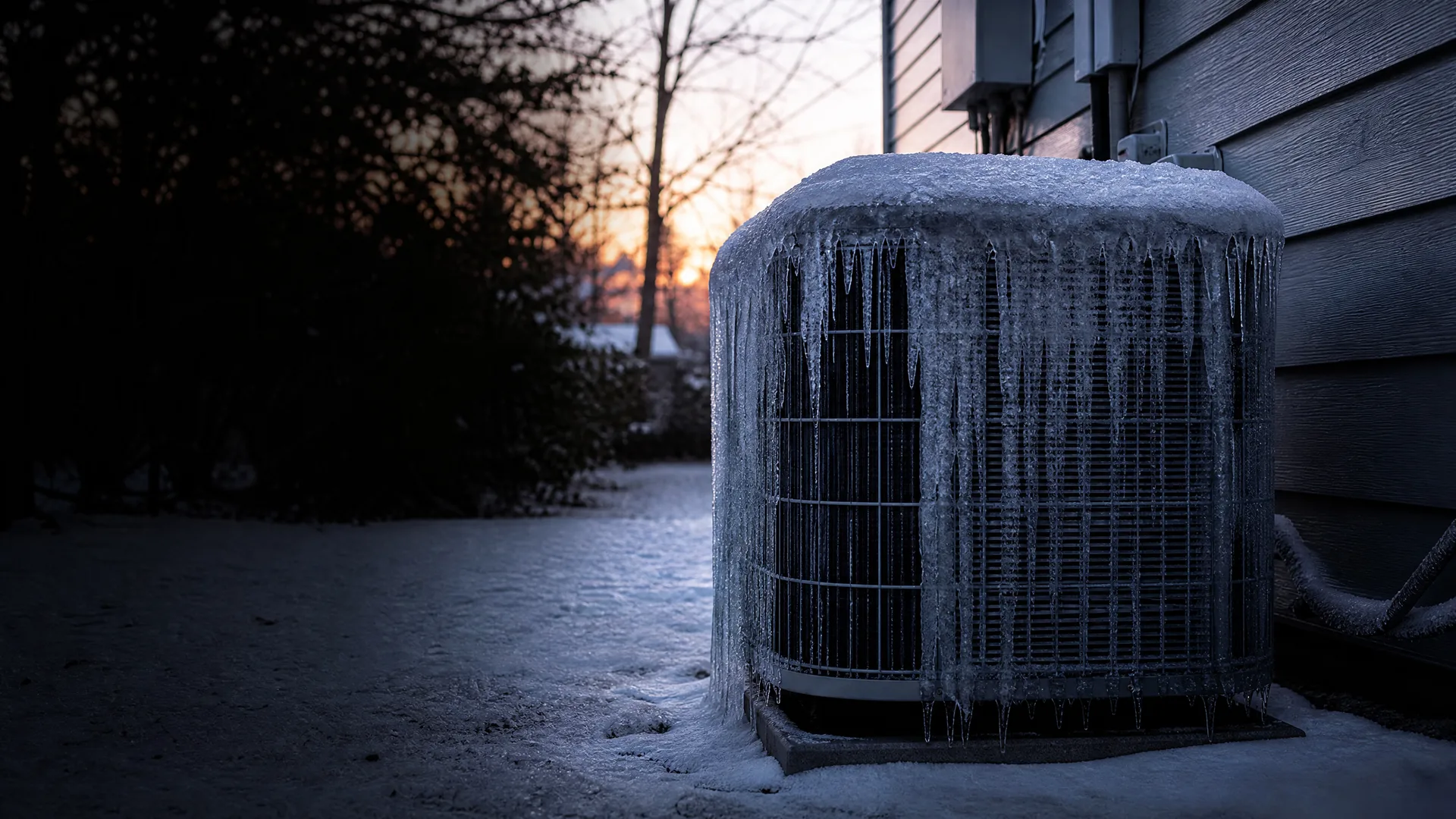
An outdoor condenser unit beside a horizontally sided house, encased in thick ice with hanging icicles, on snow-covered ground at dusk with bare trees and a sunset behind.

Six in the morning, still dark, and you go out the side door to get the trash bin before the truck comes. The outdoor unit sits against the fence, and you stop when you see it. The whole cabinet is sheathed in ice, thick over the fins, down over the base pan, nothing like the thin frost that melts off on its own. No fan noise. No hum from the compressor. Just ice, and the cold coming up through your socks. Inside, the air handler is still pushing warm air through the vents, so nobody woke up to a cold house. You stand there a minute looking at it, breath showing in the porch light, then go back in and leave the trash for next week.


A closed dark laptop and a ceramic mug of coffee on a wooden dining table, with wooden chairs, a dark kitchen cabinet with cutting boards and a potted plant, and a leafy plant by a window in the background.

Emergency heat is a sign, not a fix

Your thermostat told you something the moment it switched over: the outdoor unit stopped carrying the house on its own. Maybe it's frozen solid, maybe the compressor won't kick on, maybe a sensor is feeding it bad information. Whatever it is, the heat strips are doing the compressor's job now, and at New Hampshire's electric rates that's not a mode to leave running while you figure out next steps.

Finding someone qualified to look at it is usually its own chore, calling a few places, explaining the ice on the cabinet or the fan that spins without the compressor turning over, waiting on quotes, starting the explanation over with the next company. That part is what this page clears out of the way. One contractor, local, who services heat pumps all winter in weather like this and already knows what tends to fail when a unit ices over or goes quiet. You explain it once, to the person who's coming to fix it.

Interior corner with a beige sofa holding a dark green and a light cushion and a textured throw, a potted small-leaved tree beside a white-framed window, and a dark shallow bowl on a wooden coffee table in the foreground.
A gray outdoor heat pump unit mounted on a concrete pad beside a dark horizontal-slat clad house wall, with gravel ground and shrubs nearby.

Explain it one time

RepairHeat PumpNew Hampshire
Step 1 of 2

What ZIP code is the job in?