




A dark modern bedroom with grey bedding, a wall-mounted air conditioning unit, and a cat resting on the bed.

Mini Split Installation in Berlin, NH

Tell us about the job

Takes about a minute. No obligation.

New system or replacementMini-splitCoos County, NH
Step 1 of 2

What ZIP code is the job in?

Coos County saw 184 severe weather events between 2015 and 2024, and most of those were winter storms. That matters for where a mini split's outdoor unit goes. It needs to sit clear of roof runoff and snow slide, up on a bracket or stand high enough that drifting won't bury the coil. Wind and debris are worth thinking about too when picking a wall, not just snow. A mini split runs on the kind of power most homes already have, which counts for something in a county where storms knock out power this often.

10 months
September through June, your system heats
8°F
the average winter night it heats against
73°F
the average summer afternoon it cools against
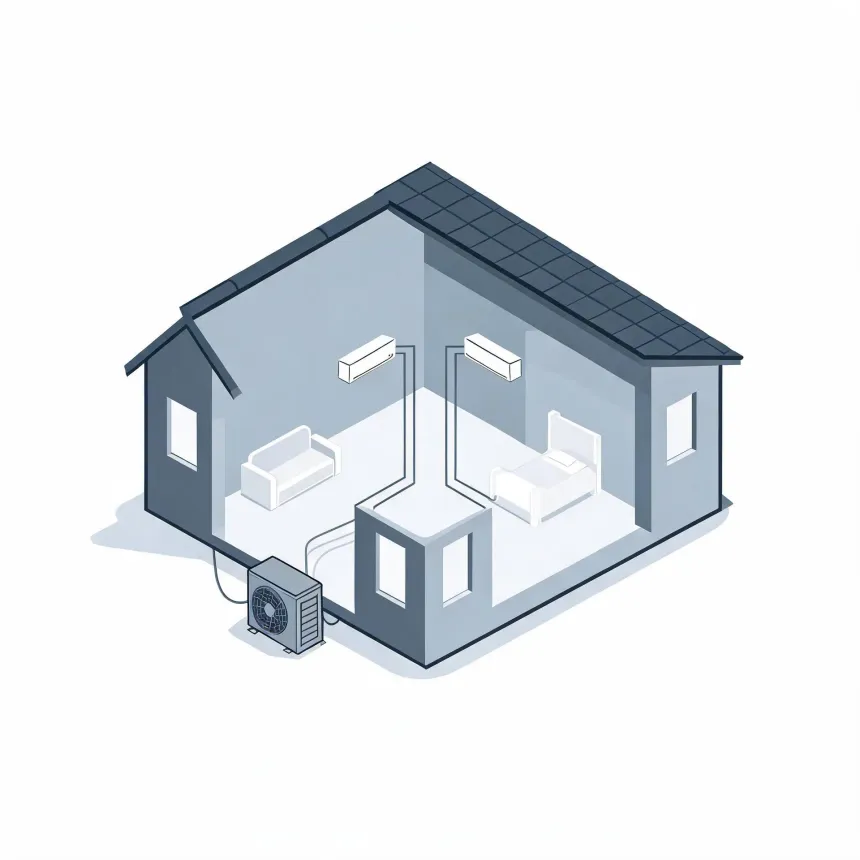
Isometric cutaway illustration of a small house showing two wall-mounted indoor air conditioning units connected by lines to a single outdoor condenser unit beside the building, with a sofa in one room and a bed in another.

A standard mini split, sized right for the room, is what most Berlin homes need.

There's nothing about this county that calls for oversizing or paying for capacity you won't use.

Most Berlin homes heat with oil, and that's exactly why a mini split makes sense

68% of homes heat with fuel oil
Summer afternoons average 73°F
62 damaging wind events from 2015 to 2024

Half the homes in Coos County were built in 1969 or earlier. In a house that age, a mini split still works the same way, but where it connects matters more. The installer has to find a wall that backs up to a room needing heat, with a clear path for the line set to the outdoor unit, and older framing sometimes makes that path less straightforward than in a house built last year. None of that rules out a mini split. It just means the walk-through before the work starts carries more weight here than it would in a newer subdivision.

A mini split here has to meet the same efficiency floor as anywhere else, and earn its keep longer

Any mini split installed here has to clear 14.3 SEER2 for cooling and 7.5 HSPF2 for heating, the federal minimum for split-system heat pumps. Coos County's cold climate rating doesn't raise that bar, but it does mean the unit is working harder, more months of the year, to hold it. A federal tax credit is available toward the cost of a qualifying system.

Find a contractor
A man in a gray rolled-sleeve shirt and brown pants, seen from behind, carries a worn canvas tool bag up concrete steps toward a green front door of a shingle-clad house, with a potted shrub beside the entry.
A white mini-split air conditioner outdoor condenser unit mounted on metal brackets against a beige stucco exterior wall, with a blue sky and scattered clouds in the background.

One season does most of the work

Summer afternoons here average 73 degrees, and most days never call for cooling at all. The outdoor unit will sit idle through what passes for summer and carry the load from the other direction, keeping the house warm through a long cold season instead. That's a one-sided job compared to what the same unit would do further south, cycling AC all summer and heat all winter both. Less switching between modes, less run time on the compressor when it's not needed. The age that catches up with a mini split here is more likely to come from years on the wall and whatever maintenance it did or didn't get, not from being pushed past what it's built for.

The rating is a ceiling, not a guarantee

SEER2 and HSPF2 are measured under set lab conditions. A unit rated at a given number can land below that in the field if the line set is too long, the charge is off, or the indoor head was never matched to the room it's heating. The number on the label tells you what the equipment is capable of, not what it will deliver on your wall.
The rating only pays off if the install backs it up

A high rating on a system that's been undersized for the room, or installed with a line set run longer than the equipment was designed for, won't hold. Sizing the head to the room and running the line set the way the manufacturer spec calls for is what lets the rated efficiency actually show up in how the system runs day to day.

If the old system is an oil furnace or boiler, that equipment usually stays put. A mini split doesn't need to tie into existing ductwork or a flue, so pulling out the old heat source isn't part of the job unless the homeowner wants it gone. Some keep the furnace running as backup for the coldest stretches and let the mini split carry the rest of the year. If there's an old window AC or a previous ductless unit coming out, the installer disconnects the line set, caps the refrigerant lines, and patches the wall where the old line ran. Any system being fully retired should have its refrigerant recovered properly rather than vented, which is something a licensed installer handles as part of the removal.

A few questions sort out a real bid from a rough guess. Ask what SEER2 and HSPF2 the system is rated for, and get the number in writing, not just "high efficiency." Ask whether the quote is for a single zone or multiple, and if it's multiple, whether each indoor head was sized for its own room or whether the whole house got one number divided up. That second approach leaves some rooms short and others oversized. Ask who's doing the line set run and whether they've looked at the wall in person, not just measured from outside. A quote based on a photo is a guess with a number attached. Ask what happens to the old system, whether it's staying as backup or coming out, and if it's coming out, who's handling the refrigerant recovery. That last part isn't optional paperwork. It's the law, and a straight answer about it tells you something about who you're hiring.