
Oil heats most homes in Sullivan County
Fuel oil or kerosene heats about half the occupied homes in Sullivan County. LP gas comes next, and electric heat is uncommon here.
Takes about a minute. No obligation.
Fuel oil or kerosene heats about half the occupied homes in Sullivan County. LP gas comes next, and electric heat is uncommon here.
A mini split doesn't replace an oil system outright. It gives you cooling and a second heat source in the rooms it serves, while the furnace keeps handling the coldest months.
NOAA nClimDiv, 1991–2020 normals
Claremont cools for one month a year, July, with afternoon highs averaging 77.
A mini split here spends most of its life idle or heating, so pick one built to last rather than one built for a heavy cooling load.




Half the homes in Sullivan County were built in 1974 or earlier, half in 1974 or later. That mix doesn't call for anything special in a mini split. A contractor sizes the unit from your square footage and room layout, and that method works the same whether the house is older or newer. Nothing about the age of the housing stock here pushes you toward a bigger unit or a higher efficiency tier than you'd need anyway. Size it for the rooms you're cooling and heating, not for when the house was built.
At 23.40 cents per kilowatt-hour, what a mini split costs to run comes down to its size matching the rooms it serves. A standard unit, sized the way a contractor sizes any mini split here, is the one built to do that.
Find a contractorJuly is the only month the cooling side of a mini split in Claremont has real work to do, at an afternoon average of 77. Outside that month it's either off or helping the furnace with heat, never pushed hard either way. A system that spends most of the year idle or working lightly doesn't wear the way one does further south. That's worth knowing when something does break. Repairing a part on a mini split that's had an easy life here is usually the right call, not a sign to replace the whole unit.
The efficiency rating tells you how much heat a mini split moves for the electricity it uses. It says nothing about whether the unit matches the room it's cooling or heating. A high rated unit sized wrong for the space still runs longer than it should and costs more than a lower rated one sized right.
The upfront price goes up with the rating. That cost is certain. What you get back depends on how many hours the unit actually runs and at what load, which a label can't tell you. A contractor sizing the unit from your rooms is what decides whether the higher tier is worth paying for.
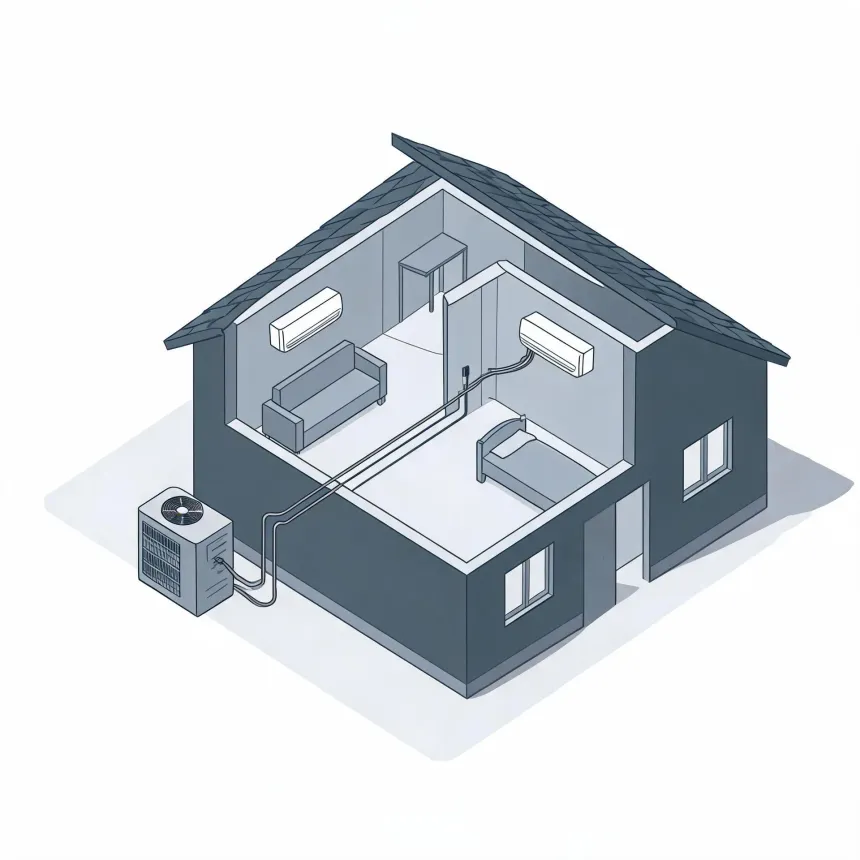
A mini split's price comes down to how many zones it's running and how much line set and wiring it takes to get refrigerant and power from the outdoor unit to each indoor head. One head in one room costs less than a system feeding several rooms, because each added head means another indoor unit, another run of line set, and another spot where the installer has to open a wall. Where the outdoor unit can sit matters too. A short, straight path to the indoor head takes less line set and less labor than a run that has to go up a wall cavity, across an attic, or around the house. Electrical work adds its own cost if the panel doesn't already have the capacity or the right circuit for the new unit. And the condition of the space counts. A wall that's easy to open and patch costs less to finish than one with plaster, tile, or trim that has to be matched back.
When you're comparing systems, ask what each one is rated to do at low outdoor temperatures, not just what it does at mild ones. Every mini split loses capacity as the air outside gets colder, but some hold onto more of their heating output than others, and that difference is what decides whether you're leaning on a backup heat source at the coldest point of winter or just on the mild days. Ask how many indoor heads the outdoor unit can run and whether it's being sized to add more later, because an outdoor unit maxed out now leaves no room to expand without replacing it. Ask about the warranty on the compressor specifically, not just the system as a whole, since that's the part most likely to be the expensive fix. And ask who's doing the actual charging of the refrigerant line, because a line set charged wrong at install will cost you efficiency for the life of the unit, no matter how good the equipment is on paper.