
A row of similar gable-roofed wood-sided houses with porches behind a long white picket fence, with mown grass in the foreground and large leafy trees behind.

Mini Split Installation in Conway, NH

Tell us about the job

Takes about a minute. No obligation.

New system or replacementMini-splitCarroll County, NH
Step 1 of 2

What ZIP code is the job in?

The rating is about the compressor, not the room

The efficiency number on a mini split tells you how well the compressor turns electricity into heating or cooling over a full season of use. It does not tell you how fast the unit will bring a cold room to temperature. A high rating on a unit that's sized wrong for the room still leaves that room slow to warm or cool. Sizing and efficiency are separate questions, and both matter when you're comparing systems.

The number assumes the system runs the way it was tested

Lab ratings assume a clean filter, a properly charged line set, and an outdoor unit with nothing blocking its airflow. A mini split installed with room to breathe and kept up over the years will run close to its rated efficiency. One crowded against a wall or buried in brush, or never serviced, drifts further from that number every season it runs.

9 months
September through May, your system heats
1 months
July through July, it cools
12°F
the average winter night it heats against
77°F
the average summer afternoon it cools against
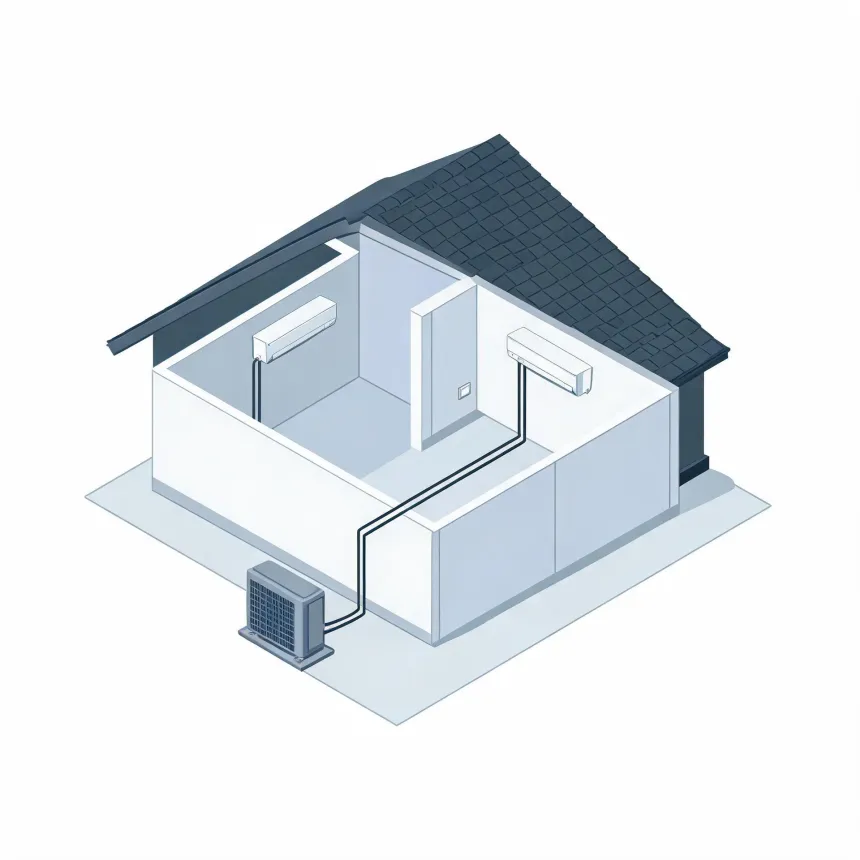
Isometric cutaway illustration of a small house with a dark shingled roof, showing two wall-mounted indoor air conditioning units in separate rooms connected by lines to an outdoor condenser unit on the ground outside.
Your system heats September through May and cools July through July.

NOAA nClimDiv, 1991–2020 normals

July is the only month Conway homes run cooling, with afternoon highs near 77°F.

A mini split here spends most of the year on heat, not AC, so pick it for reliability through a long cold season rather than for cooling power it rarely needs.

Most homes here run on oil, which is exactly why a mini split makes sense

42.1% of homes heat with fuel oil
Cooling runs July through July
Summer afternoons average 77°F
A standard system, sized right for this houseNew Hampshire households paid 23.40 cents per kilowatt-hour in 2024, and a correctly sized mini split keeps that cost in check.

Carroll County is zone 6A, a cold, humid zone with winter running long here. Any mini split installed now, if manufactured from 2023 on, has to clear 14.3 SEER2 for cooling and 7.5 HSPF2 for heating. That's the federal minimum for split-system heat pumps, and the standard doesn't carve out a separate rule for ductless units. So the mini splits sold here already meet a baseline built for a cold climate, not a mild one. A system that clears these minimums may also qualify for a federal tax credit, worth checking against the model you're considering.

July is the only month to plan around

Cooling here runs one month a year, July. Installing before June means the mini split is tested and running before it has to earn its keep, instead of getting set up while the house is already warm.

Find a contractor
A man in a cap, dark long-sleeve shirt and tan work pants walks up porch steps toward a green front door, carrying a worn canvas duffel bag, with a potted shrub and wall lantern beside the entry.
A white mini-split air conditioner outdoor condenser unit mounted on metal brackets against a beige stucco exterior wall, with a blue sky and scattered clouds in the background.

It runs nearly every day of the year, not just in weather extremes

A furnace shuts off completely for months at a stretch. A mini split doesn't get that break. It's either heating, cooling, or sitting in standby with power still running to the control board, so the compressor racks up far more hours over a year than a furnace ever sees. That shows up first in the parts working hardest, the compressor bearings, the outdoor fan motor, the reversing valve that switches the system between heat and cool. None of that is a flaw. It's what the system was built to do. But it's also why the filter and the outdoor coil need checking on a schedule instead of waiting for a noise or a warm room to bring it up. A dirty filter makes the indoor fan push harder for the same airflow. A coil packed with leaves or dust makes the compressor run longer to move the same heat. Both show up as longer run times well before they show up as a failure.

Sizing comes from a room by room heat loss calculation, not square footage

A contractor works out how fast a room loses heat in winter and gains it in summer, based on the walls, windows and ceiling in that specific room. Square footage alone skips all of that, which is why rooms that look alike on paper can need different size heads. The output has to match what the room actually loses, not a rule of thumb.

Oversized or undersized, the mini split runs worse either way

A unit too big for the room cools or heats it fast, then shuts off, and that short cycling leaves the room swinging between too warm and too cold while the compressor wears against its own stop-start pattern. A unit too small never stops trying, running long stretches without catching up on the coldest or hottest days. The right size is the one that runs long steady cycles and holds the room where you set it.

If this is replacing an oil or electric system that heated the whole house, the old equipment usually doesn't come out the same day the mini split goes in. A contractor disconnects it and caps it off so it's safe to leave, then the removal gets scheduled on its own, especially if there's an oil tank involved. If the old system is forced air, the ductwork underneath often stays in place even after the furnace is gone, since pulling ducts out of walls and floors is a separate job from swapping the equipment. Baseboard heat usually gets capped at the line rather than torn out, in case a room still needs it on the coldest days. Worth asking the contractor straight out what happens to the old unit and whether removal and disposal are part of the job or billed separately.

Installation day starts with the outdoor unit. It needs a pad or wall bracket set level, with space around it for air to move freely for as long as it runs there. The line set runs from that outdoor unit through a hole drilled in the wall to the indoor head, carrying refrigerant lines, a drain line, and electrical wiring bundled together. Once both units are mounted and connected, the line set gets pulled down to a vacuum to clear out air and moisture before any refrigerant moves through it. Skipping that step is what leads to a system that never quite performs right, no matter how well it was sized. After the vacuum holds, the contractor charges the line, powers up the system, and checks that it's cooling or heating properly before calling the job done.