




A row of similar gray-sided houses with dark shingled roofs behind a new wooden picket fence, with a mown grass lawn in the foreground and leafy tree branches overhead.

Mini Split Installation in Keene, NH

Tell us about the job

Takes about a minute. No obligation.

New system or replacementMini-splitCheshire County, NH
Step 1 of 2

What ZIP code is the job in?

Cheshire County gets rough weather often, 164 damaging wind events alone in the last decade. A mini split's outdoor unit sits outside taking all of it, so where it goes matters. Mounting it clear of roof runoff and falling branches, on a stand above the snow line, cuts down on what the weather can do to it. The bigger issue is power. A mini split won't heat or cool without it, and a lot of homes here have gone a full day or more without. If your area loses power often, ask about backup options before the install, not after.

9 months
September through May, your system heats
2 months
July through August, it cools
15°F
the average winter night it heats against
78°F
the average summer afternoon it cools against
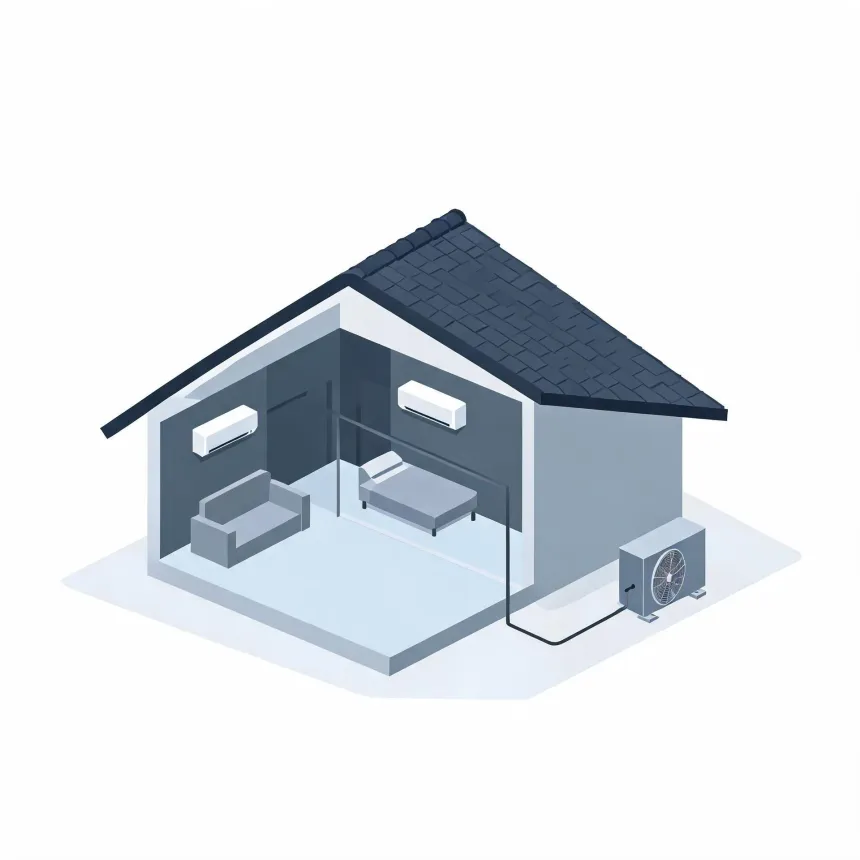
Isometric illustration of a cutaway house showing two wall-mounted indoor air conditioning units connected by a line to an outdoor condenser unit beside the building, with a sofa and bed inside.
Your system heats September through May and cools July through August.

NOAA nClimDiv, 1991–2020 normals

Keene doesn't need an oversized mini split or a high-end efficiency tier to heat and cool a typical home here.

A correctly sized standard system costs less to buy and keeps your electric bill down at 23.40 cents per kilowatt-hour, New Hampshire's 2024 rate.

Short summers mean the strain on this system is light

Cooling runs July through August
Summer afternoons average 78°F
164 damaging wind events from 2015 to 2024

June is the month to get a mini split installed here, not July. Cooling only runs two months in Cheshire County, July through August, so there's no long runway once the heat sets in. Installers book up fast once the first hot week hits and everyone calls at once. Going in June means the unit's charged, mounted and tested before you actually need it, with time to fix anything that's off. Wait until July and you're running a brand new system on the first day you lean on it, with no slack if something needs adjusting.

Any mini split installed here has to clear 14.3 SEER2 and 7.5 HSPF2

Cheshire County sits in climate zone 5A. A mini split installed here has to meet the federal minimum for split systems, 14.3 SEER2 for cooling and 7.5 HSPF2 for heating. That floor applies whether the unit is ductless or not. The standard names no separate class for mini splits. A system that meets this minimum qualifies for the federal tax credit.

Find a contractor
A beige split-system air conditioner outdoor condenser unit mounted on metal wall brackets atop a stucco wall.

Half these homes were built in 1972 or earlier, and that shapes the install

Half the homes in Cheshire County were built in 1972 or earlier. A mini split doesn't care how old the house is, but whoever installs it needs to know what's behind the wall before mounting the indoor unit and running the line set outside. An older home can mean older framing or siding that changes where the line set runs and what the install has to work around. Worth walking through with the installer before anything gets mounted, not after.

Sizing comes from a room by room look, not a guess

A proper install starts with a load calculation, checking square footage, window placement, insulation and ceiling height in the specific rooms getting coverage. Square footage alone doesn't tell you enough. Rooms the same size can need different output if one faces south with big windows and the other doesn't. The calculation decides which indoor unit goes where and what the outdoor unit needs to handle all of them.

Oversized hurts the system you're buying

A mini split that's too big cools the room fast, shuts off, and starts again soon after. That cycling leaves the room damp and uneven, and it wears the compressor down faster than steady runtime would. Undersized has its own problem. The system runs constantly and never quite catches up on the hottest or coldest days. Right sized means it runs long steady cycles and actually controls the humidity in the room.

If what's coming out is a central furnace and central air setup, taking it out is its own job. A furnace comes out in pieces once the ducts are disconnected, and the old line set and refrigerant from a central AC have to be recovered properly, not vented. If a mini split is replacing another mini split, the old outdoor unit gets unbolted from its mounting, the indoor head comes off the wall, and the line set gets pulled from wherever it was run. Either way the refrigerant in the old system has to be recovered by someone certified to handle it. It doesn't just get released. Whoever installs the new system can usually handle hauling off the old equipment as part of the job, so it's worth asking rather than arranging separate disposal yourself.

Install day starts with the outdoor unit placement and the line set path getting walked one more time, then the holes get drilled. The line set runs through a single hole in the wall, carrying refrigerant lines, a condensate drain and electrical wiring together, usually wrapped or bundled so it's one clean pass rather than several. The indoor head mounts on a bracket first, then gets connected once the wall is open. Outside, the lines get connected to the condenser, and the whole system gets vacuumed down to pull moisture and air out of the lines before any refrigerant moves through them. Skipping that step is what leads to a system that runs weak or trips out early. Once it's sealed, the refrigerant gets released into the lines, and the installer checks the charge against what the manufacturer specifies for that line length, not just a gauge reading that looks about right. Last comes the test run, heating and cooling both, checking that every head responds and the condensate drains where it should.