





A two-story red brick house with dark shutters and a gray roof sits behind a mowed lawn, a dry-stacked stone retaining wall, and large deciduous trees under an overcast sky.

Mini Split Installation in Portsmouth, NH

Tell us about the job

Takes about a minute. No obligation.

New system or replacementMini-splitRockingham County, NH
Step 1 of 2

What ZIP code is the job in?

Rockingham County saw 200 severe weather events between 2015 and 2024, and damaging wind was behind most of them. A mini split's outdoor unit hangs on an exterior wall, exposed to whatever that wind carries. Where the installer mounts it, and what's nearby to block the worst of it, matters more here than in a calmer county. Almost a quarter of New Hampshire households went at least a day without power last year. A mini split with its own circuit still won't run with the power out, so if backup power matters to your heat, ask the installer how this system fits into that plan.

8 months
October through May, your system heats
2 months
July through August, it cools
18°F
the average winter night it heats against
80°F
the average summer afternoon it cools against
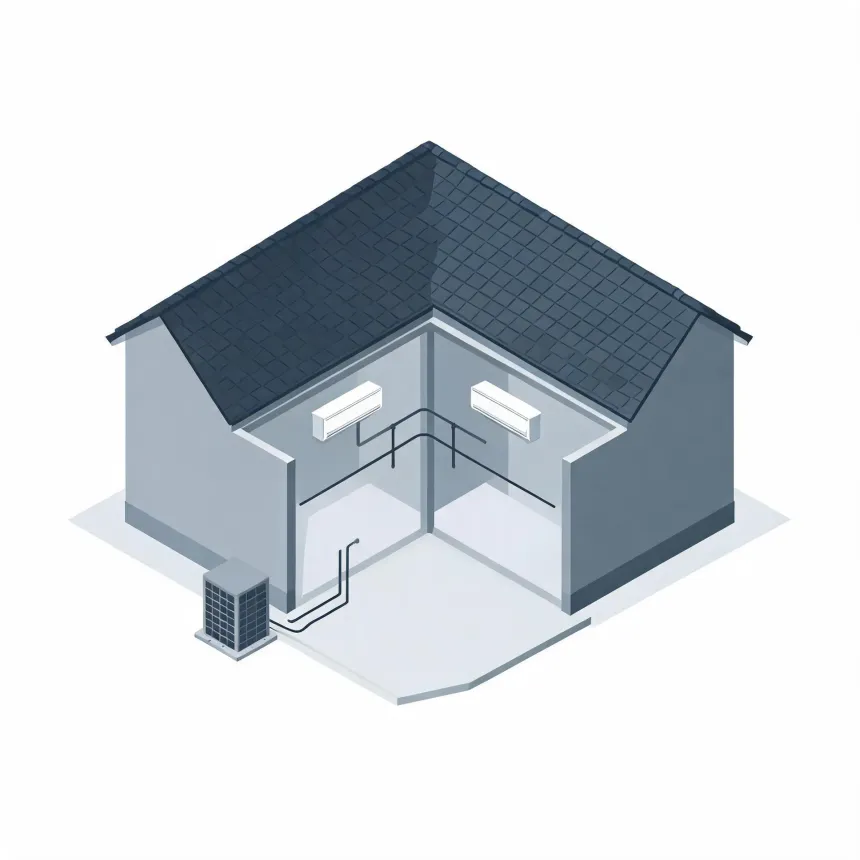
Isometric illustration of a cutaway gray house with a dark shingled roof, showing two wall-mounted indoor air conditioning units connected by piping to an outdoor condenser unit on the ground outside.
Your system heats October through May and cools July through August.

NOAA nClimDiv, 1991–2020 normals

Fuel oil or kerosene heats 42.2% of homes in Rockingham County, more than any other fuel.

A mini split runs on electricity, so for most homes here it's adding a second system, not swapping out the first.

Cooling runs two months here. Get the install done before July.

Cooling runs July through August
Summer afternoons average 80°F
103 damaging wind events from 2015 to 2024

A mini split sized to the room it's heating or cooling is enough here. Nothing about Portsmouth calls for oversizing the unit or stepping up to a pricier efficiency tier. What's worth knowing instead is the electric rate. New Hampshire homes paid 23.40 cents per kilowatt-hour in 2024, above what most of the country pays. That's the number to weigh against a system's efficiency rating when you're comparing models, more than the price on the quote. A unit sized to the room, not the whole house, is what keeps the monthly cost down.

Meet the 2023 efficiency standard and claim this year's credit

Zone 5A puts Rockingham County in cool, humid territory, and any mini split installed here has to meet 14.3 SEER2 and 7.5 HSPF2, the federal minimum for split-system heat pumps made from 2023 on. That floor applies whether the install happens now or next year. A federal tax credit is available for qualifying heat pumps installed this year.

Find a contractor
A man in a cap, dark shirt and brown work pants, seen from behind, climbs wooden porch steps toward a green front door while carrying a worn canvas bag.
A white outdoor air conditioner condenser unit mounted on metal wall brackets against gray horizontal siding, with a blue sky and white clouds behind it.

Two months of cooling a year

Cooling runs two months here, July and August, with afternoon highs around 80. Heating carries the rest of the year, since the county sits in zone 5A where heating is the bigger load. Two months of cooling a year is a light duty cycle for a compressor. A unit sized to one room isn't working hard in either season. That doesn't mean the install details stop mattering. Wind and the odd hail event still reach the outdoor unit whether the compressor is loaded or not. But years from now, if something goes wrong, a light duty cycle like this points to age or a skipped maintenance visit, not a system that got worked too hard.

Someone has to deal with the old unit

Whatever is heating or cooling that room now has to come out before the new line set goes in, whether that's a window unit, baseboard heaters, or an older mini split. Disposal and any electrical disconnect are usually part of the installer's scope, worth confirming before the work starts rather than after.

An old wall sleeve or line set rarely gets reused

A new mini split usually means new refrigerant lines and a new wall penetration sized for them, even if an old one is sitting right there. Mixing old copper or an old hole with new equipment is how leaks and bad connections start, so most installers run fresh line set rather than patch into what's already there.

What moves the price on a mini split job is mostly hidden until the installer looks. How far the indoor head sits from the outdoor unit matters, since the line set has to run between them, through a wall and often along it, and every extra foot is more copper, more refrigerant, more time. The wall itself matters too. Running line set through siding is one job, through brick or block is another, and the crew has to plan around studs and whatever is already in that wall. The electrical side counts as much as the line set. A mini split needs its own dedicated circuit, and if the panel has room and capacity waiting, that's a short job. If it doesn't, running new wire back to the panel, or even upgrading the panel, adds real work before the unit itself goes in. Where the outdoor unit lands plays in too, since a long or awkward path to the mounting spot takes more time than a straight shot. None of this shows up on a spec sheet. It shows up when someone's standing in the room looking at the wall.

The crew starts outside, mounting the bracket for the outdoor unit and running the line set from there to the spot picked for the indoor head. That line set carries refrigerant, so once it's connected, the whole system gets pulled down to a vacuum before anything is charged. This step pulls out moisture and air that don't belong in the lines. Skip it and the system can still run, but moisture mixed with refrigerant corrodes the copper and the coil from the inside over time, so a tech checks the vacuum gauge and holds there before moving on. Only after that does the system get its charge and get powered up. The indoor head gets mounted, leveled, and connected last, then the whole thing runs through a cycle in both heating and cooling before anyone calls it done.